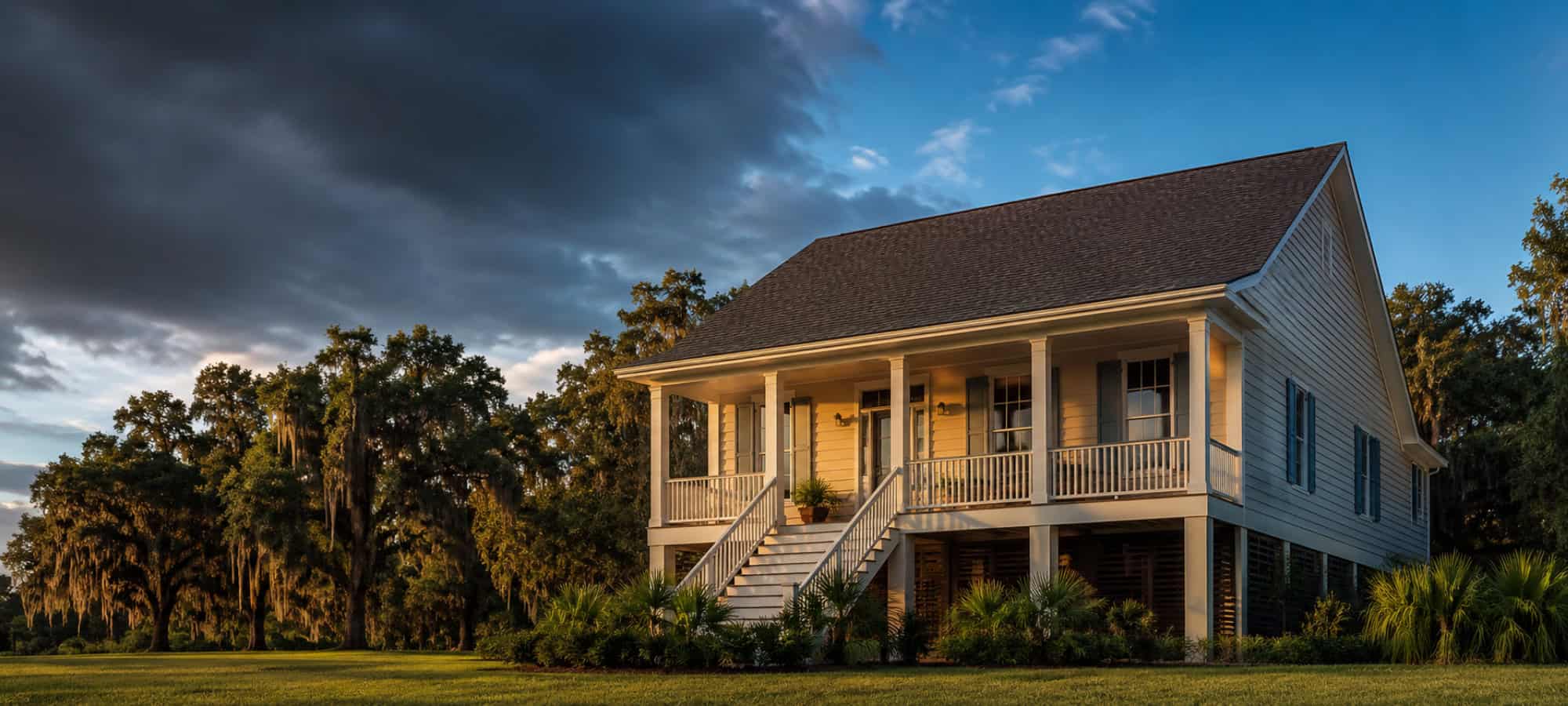
No new roof needed
Keep Your Roof. Make It FORTIFIED.
If your roof is still in good shape, you may be able to earn a FORTIFIED Roof designation without tearing it off. IBHS allows the roof deck to be sealed and re-attached from inside the attic using closed-cell spray foam. The certificate that results is called FORTIFIED Roof - Existing Roof, and it earns the same mandated wind discount as a new roof.
When a Gulf storm strips the covering off a roof, what saves the house is the deck underneath. If the panels lift or the seams open, the rain that follows goes into the ceilings, into the floors, and into everything you own. Sealing and bonding that deck is the part of the job that decides whether a lost covering stays a roofing problem or becomes a house problem. It is also the part you can do without replacing a roof that is still working.
Whether your roof qualifies
IBHS calls this the Existing Roof path, and it has a short list of conditions. Every one of them has to hold.
- Your roof still has real life left in it. The test is not how old the roof is. IBHS asks whether the covering has roughly five years or more of useful life remaining, judged on the type of roof, its age, its condition, and any visible wear or corrosion. A twelve-year-old architectural shingle roof in good condition can pass this. A six-year-old roof that took a beating may not.
- No visible damage or deterioration.
- One layer of roofing, not two. If an older covering was left in place and roofed over, this path is closed. FORTIFIED does not accept layovers, and requires the old covering to come off before a new one goes on.
- A plywood or OSB deck. Homes with wood plank decking cannot use the spray foam method at all. Boards move with the seasons, and the foam cannot hold a permanent bond across gaps that open and close.
- An attic you can reach, all of it. The installer has to get to the entire underside of the deck. Low eaves, ductwork, an air handler, or a finished attic ceiling can block exactly the areas that matter, and any section the foam cannot reach has to be sealed another way.
- A drip edge already installed.
A certified FORTIFIED evaluator makes the actual call. This list is what they check against, not something you can settle from the ground.
How the work is done
The crew works from inside the attic. They lay a bead of two-part closed-cell spray polyurethane foam, one and a half to three inches wide, along every seam between the deck panels, along every place the deck meets a rafter or truss, and up all the valleys.
That single application does two things the FORTIFIED standard asks for separately. It seals the deck against water, and it bonds the panels to the framing so wind cannot pull them off.
The product has to be tested and rated to hold at least 110 pounds per square foot of uplift. Your evaluator will want a letter from the installer naming the product, the manufacturer's documentation, and at least four photographs taken from four different parts of the attic showing continuous coverage. There is no way to judge cured foam by looking at it, which is why the paperwork matters as much as the work.
What it is worth
The certificate is what triggers the money, not the method you used to earn it.
A FORTIFIED Roof - Existing Roof certificate is a FORTIFIED Roof designation, so Louisiana's mandated wind discount applies to it. Under Regulation 136, the benchmark runs 16 percent in the North zone to 29 percent in the South zone, taken off the wind or hurricane portion of premium, and those benchmarks become mandatory January 1, 2027. Top carriers already file up to about 40 percent today.
Which carrier files what, and what the discount comes to in dollars, is worked through on the wind insurance discount page.
The state tax credit is keyed to the certificate the same way. It returns 100 percent of qualified costs, up to $10,000 per residence, for costs incurred on or after July 1, 2025, and it sunsets December 31, 2031.
Who can claim it, how the carryforward works, and how it interacts with a grant are covered on the FORTIFIED roof tax credit page.
Estimate the yearly discount
Put in the wind or hurricane portion of your premium and your zone. The number is the same either way you earn the designation, because the discount follows the certificate. It is a planning estimate, not a quote.
Enter the wind or hurricane portion of your premium, not the whole bill. On a coastal policy it is often the largest line.
Enter your wind premium above to see the estimated yearly discount.
Estimate only, based on the Regulation 136 benchmark for your zone and filed carrier discounts. It is not a quote. Your actual discount depends on your insurer, your policy, and your FORTIFIED level.
An estimate is not a quote. A FORTIFIED-certified contractor can confirm what your carrier files and what the work would cost on your roof.
Get a real quoteThe grant question
On the Fortify Homes grant, LDI has not published an answer. Regulation 126 and the LFHP homeowner rules both require only that the work meet or exceed the IBHS FORTIFIED roof standard. Neither says whether the roof covering has to be replaced, and neither mentions this method either way. In practice your Home Evaluator determines which improvements your home needs to meet the standard.
So ask LDI and ask your evaluator before you assume it either way. Registration for the most recent round closed June 19, 2026 and LDI has said further rounds will be announced later, so there is time to get a real answer. Apply through the state at ldi.la.gov/fortifyhomes, not on this site.
What it costs
We do not publish a cost figure for this work, because there is no sourced Louisiana number for it and we will not invent one. For scale: a full FORTIFIED roof replacement runs about $16,229 at the documented median. This is a smaller and different job, priced off the size of your attic and how easy it is to move around in.
Anyone who quotes you a firm number before looking in your attic is guessing.
By Louisiana Fortified HomesUpdated
Find out whether your roof qualifies
Tell us about your roof and we will connect you with a FORTIFIED-certified contractor in your parish. They can look at your roof and your attic and tell you whether the attic-side path is worth pursuing, or whether a full replacement is the honest answer. The formal decision belongs to a certified FORTIFIED evaluator. No cost, no obligation.
How getting connected works
Tell us about your home
Share your ZIP code and a few details about your roof. It takes about a minute, and there is no cost.
We connect you with a certified roofer
We put you in touch with a FORTIFIED-certified contractor who works in your parish.
Get a free, no-obligation bid
They look at your roof and give you a real number. No pressure, no obligation.
You are working with FORTIFIED-certified roofers and an independent guide, not an insurer or a government program.