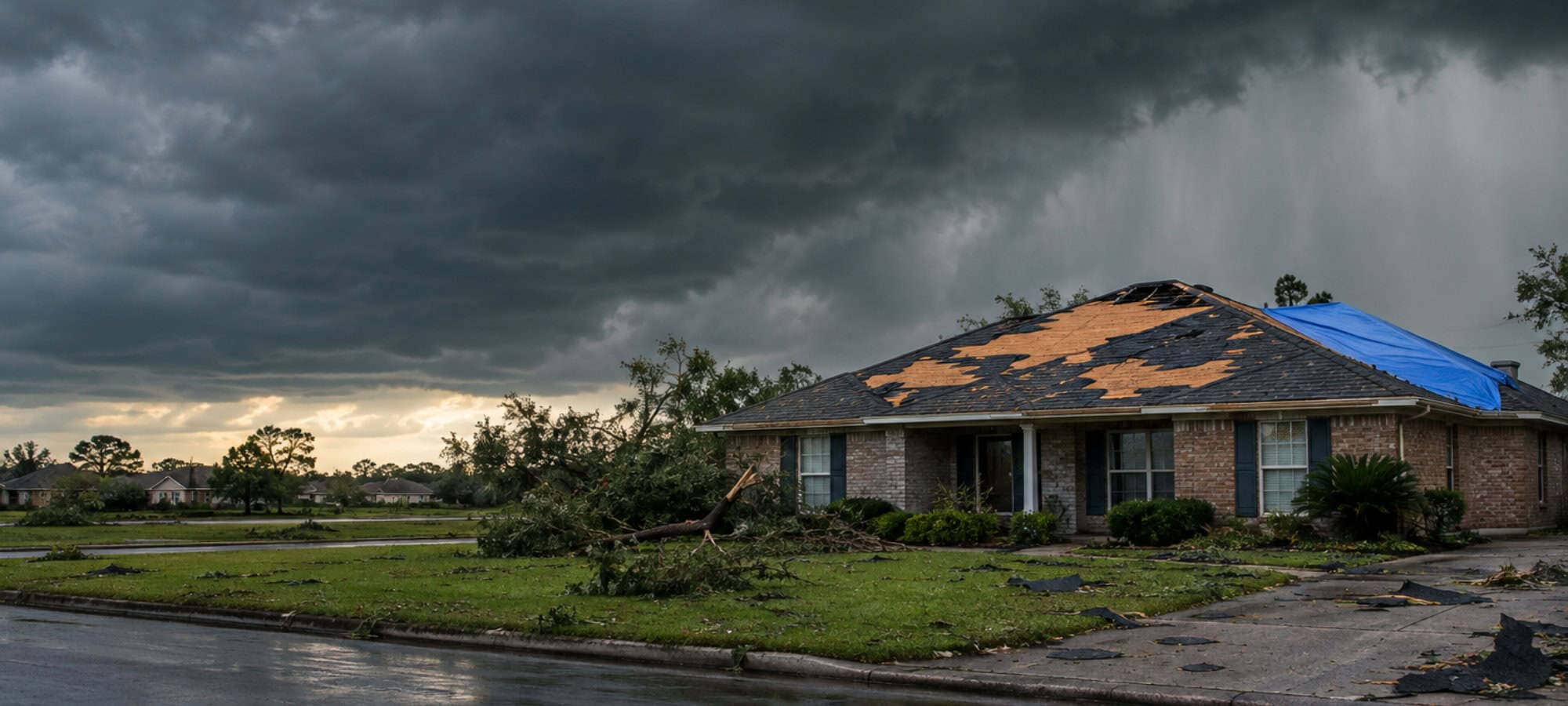
Storm damage
Storm Damaged Your Roof? Here Is What to Do Next.
Every rain on a damaged roof is new damage. Get it covered, get it documented, and get a free quote from a local roofer today.
If a storm has damaged your roof, do three things today: photograph everything, stop the water with a tarp or a temporary repair, and call your insurance company. Then hold off on permanent repairs, and on signing anything, until you have talked to your insurer and the adjuster has seen the damage. Below are the five steps, the deadlines Louisiana law puts on your claim, how to spot a storm chaser, and why a roof that insurance is already replacing is the best chance you will get to make it FORTIFIED.
Do these five things now
- Photograph everything before you clean up. Take photos and video of the damage, inside and outside, with the time and date stamp turned on.
- Stop more damage. Tarp the roof or make temporary repairs to keep the weather out. Keep every receipt and a note of what was done, because temporary repair costs may be reimbursable under your policy.
- Hold off on permanent repairs. Do not replace the roof or make permanent repairs until the adjuster authorizes them.
- Call your insurer, and log every call. Write down the name of the person you spoke with and the date and time of each call.
- Sign nothing until you have talked to your insurer. No contract and no work order, from anyone, before that conversation.
These steps come from the Louisiana Department of Insurance guides Cleaning Up After the Storm and its homeowners insurance guide.
Talk to a local roofer now.
Call Now: (504) 520-4274Why the tarp cannot wait
Your policy requires you to protect the home from further damage once it has been hit. That duty is written into Louisiana's standard fire policy (La. R.S. 22:1311). A roof left open lets water into the decking, the insulation, the ceilings and the floors, and every rain after the storm turns a roof claim into a bigger one and a longer fight. The fix is simple and it is in your hands: a tarp today, a roofer this week.
The deadlines that matter
- 30 days to start. After a declared disaster, your insurer must start adjusting your claim within 30 days of your notice of loss. The Insurance Commissioner can extend that by up to 30 more days (La. R.S. 22:1892(A)(3)).
- 60 days to pay. After a declared disaster, it must pay what it owes on a home claim within 60 days of satisfactory written proof of loss (La. R.S. 22:1892.2(A)(2)).
- 1 year to rebuild. After a declared disaster, with replacement-cost coverage, you have 1 year from the loss or from the insurance payment, whichever is later, to finish repairs and recover the depreciation held back (La. R.S. 22:1264(B)).
- 24 months to sue. You have 24 months from the loss to sue on the policy, and the policy cannot shorten that (La. R.S. 22:1311 and R.S. 22:868(B)).
Do not sit on it.
If insurance is replacing your roof, make it FORTIFIED
A roof that is coming off anyway is the best time to build it to the FORTIFIED standard. IBHS puts the added cost at typically $1,000 to $3,000 when re-roofing a 2,000 square foot home. That is a national figure, and a Louisiana quote can differ.
- Ask about the FORTIFIED endorsement. Louisiana law requires homeowners insurers to offer an endorsement that upgrades the roof to the FORTIFIED standard when covered damage means it has to be replaced (La. R.S. 22:1483.2). Ask your insurer whether your policy has it. Do not assume a policy without it pays for the upgrade.
- The designation pays you back. A FORTIFIED roof earns Louisiana's required insurance discount on the wind portion of your premium.
- The tax credit counts what you pay. The state FORTIFIED roof tax credit is figured on the qualified costs you pay yourself, up to $10,000. You cannot claim both the credit and the grant.
- The grant can cover the gap, with a catch. The Fortify Homes grant can pay the difference between your claim payment and the cost of a FORTIFIED roof, but only if you are accepted into the program before you hire anyone or start work. As of August 2026, registration is closed.
A certified FORTIFIED evaluator has to document the roof while it goes on, and since November 1, 2025 a certified FORTIFIED roofing company has to install it. Decide before the old roof comes off.
Storm chasers: how to tell a real roofer
After a storm the trucks show up fast, and not every one of them belongs to a licensed roofer. Before you sign or pay anyone, run them through the Louisiana contractor license lookup and hold them to these rules.
- Check the license. Roofing work on a home with a project value of $7,500 or more requires a license from the Louisiana State Licensing Board for Contractors, in the Residential Roofing or Residential Construction classification. Look the roofer up with the LSLBC license lookup before you sign.
- No one can “cover your deductible.” A roofer who offers to waive, pay, or rebate your deductible without your insurer's consent is breaking Louisiana law (La. R.S. 51:451).
- Do not sign away your claim. Louisiana bans assignment-of-benefits agreements, the forms that hand your insurance claim to a contractor. They are void (La. R.S. 22:1275).
- A roofer is not your adjuster. A contractor cannot adjust your claim for you as a public adjuster or advertise as an “insurance claims specialist” (La. R.S. 37:2159.1).
- Keep control of the money. Pay by check or credit card, not cash, so there is a record. Do not pay the full cost up front, and do not agree to a payment schedule built on a large payment before the work.
- Be wary of anyone who shows up uninvited. The Department of Insurance tells homeowners to be wary of anyone they did not contact who offers to do work on the home.
A license and FORTIFIED certification are two different credentials. If you want the roof rebuilt FORTIFIED, check the roofer in the IBHS directory of FORTIFIED professionals too. For the rest of what to ask, see choosing a contractor.
Emergency tarps and Operation Blue Roof
After a major disaster, the U.S. Army Corps of Engineers may run Operation Blue Roof for FEMA, covering damaged roofs with reinforced sheeting until permanent repairs can be made. It is free. It serves primary homes and permanently occupied rentals, not vacation rentals, and it only runs once FEMA assigns the mission at the state's request. Check blueroof.gov to see whether a mission is active. The number is 1-888-ROOF-BLU (1-888-766-3258).
Otherwise, a roofer tarps the roof. Keep the receipt, because it belongs with your claim.
Your hurricane deductible
Your policy may carry a separate deductible for named storms. The Department of Insurance says it typically runs 2 to 5percent of the home's insured value. On a home insured for $200,000, a 5 percent deductible means the first $10,000 of repairs is yours.
By Louisiana law it applies once per calendar year, across every named storm that year. If a second storm hits, what you already paid can count toward it, and your insurer can ask for receipts to prove it. Keep them.
FEMA and SBA, briefly
FEMA help covers only damage your insurance does not, so you file with your insurer first. SBA disaster loans let homeowners borrow up to $500,000 to repair or replace a primary home.
By Louisiana Fortified HomesUpdated
Storm damage? Get a roofer on it this week.
Tell us what happened and we will connect you with a FORTIFIED-certified contractor near you. No cost, no obligation. Getting ready for the next one? Here is what to do before the storm.